Showing posts with label volcano. Show all posts

Monday, June 28, 2010

Italy in Geological News

First a volcano-related item: How did the victims of the Plinean Eruption of Vesuvius die - a summary from io9, of an article assessing how the victims of the Vesuvius eruption died. It will come as no surprise to anyone familiar with how freaking scary pyroclastic flows are that they died from being flash-cooked by the extreme heat of the flow, rather than suffocated by it.

And then, Italian scientists who failed to predict L'Aquila earthquake may face manslaughter charges. Argh. Argh argh argh. Considering how inherently unpredictable earthquakes are - more unpredictable than volcanic eruptions or tsunami - I was primed to be ticked off from the instant I read the headline. The article mentions foreshocks (one of them a 4.0) but the problem there is that you can only really classify a foreshock in hindsight. Was the magnitude 4.0 the prelude to a bigger earthquake, or an earthquake in its own right? There's no way of knowing for certain until after you get hit by (or fail to be) by a much larger quake.
"Those responsible are people who should have given different answers to the public,” said Alfredo Rossini, L'Aquila's public prosecutor. “We're not talking about the lack of an alarm, the alarm came with the movements of the ground. We're talking about the lack of advice telling people to leave their homes."

This is the ultimate in damned if you do, damned if you don't situations. If you warn people to leave their homes because a natural disaster is imminent and it doesn't happen, you catch flak - think about the complaining that came after the tsunami that did hit Hawaii wasn't the monster wall of water that makes up journalistic wet-dreams. But if you don't tell people to clear out of their homes because there's the possibility of an inherently unpredictable event occurring, then you get in trouble for that as well. Hindsight is 20/20, particularly when it comes to earthquakes. Though this:
At a press conference after the meeting, government official Bernardo De Bernardinis, deputy technical head of the Civil Protection Agency, told reporters that "the scientific community tells us there is no danger, because there is an ongoing discharge of energy. The situation looks favorable.” In addition to the six scientists, De Bernardinis is also under investigation.

Also really doesn't help. Small earthquakes might release some stress on a fault, but that also might add stress to a different portion of the same fault, or another fault nearby. The environment of stress and faulting that goes on beneath us is too uncontrolled and not well mapped enough to allow for the incredibly accurate modeling you'd need to be able to say something like that. So if that's something the seismologists in question were telling the government, shame on them. But I also have a hard time imagining any geologist worth his or her salt saying that unless they were simultaneously on some kind of mind-altering drug regimen, so I'd really like to know just who in the "scientific community" De Bernardinis was referring to. For all I know, the "scientific community" is a bright blue space elf that only he can see.

What a horrible situation. And way to make "Italian seismologist" a very unappealing job title.

Tuesday, May 18, 2010

Happy Anniversary, Mount St. Helens!

You exploded in a spectacular fashion 30 years ago today! If I'd thought about it, maybe I would have tried to bump my wedding 4 days earlier just so I could have a shared anniversary.

...just kidding. Mostly.

There's going to be less than normal going on in this blog for the next couple of weeks, FYI. Because there's this wedding thing, and guests from out of town, and I'm sort of running frantically around. I'm just happy that thus far that the volcano at Eyjafjallajökull has not prevented any of my British friends (and family-to-be) from making it across the Atlantic, but the game's not over yet.

Thursday, April 01, 2010

Volcano cam

This is pretty cool: Volcano cam of the Eyjafjallajoekull volcano, courtesy of Vodafone Iceland. And there's enough going on with the eruption that a second vent has opened up. That's some pretty exciting stuff!

Not quite sure how I feel about chefs cooking meals over the lava. I mean, I guess if there's not much danger (since we're talking an effusive rather than incredibly explosive eruption), there's no reason not to. At least they're cooking on the stuff that's actually already cooled quite a bit.

Monday, March 29, 2010

Volcano for Monday

Italy is one of those places where you may think about volcanoes (hello, Pompeii), but you don't tend to consider tsunami hazards. Apparently they've got a real doozy, though, in the form of the Marsili Volcano. It's an undersea volcano, and there are concerns that an eruption (and the subsequent likely collapse of its sides) could cause a tsunami that would be bad news for Naples and anyone else around the Mediterranean.

And, as usual, the important word about risk:
"While the indications that have been collected are precise, it is impossible to make predictions. The risk is real but hard to evaluate."

Like with all volcanoes, the possibility is real, but impossible to predict when something might happen. It sounds like "soon," but we're also talking a geological "soon." It could be next week. Or it could be some time long after human beings have colonized other planets and turned Earth in to a giant historical theme park.

Monday, March 22, 2010

Volcano for Monday

Eyjafjallajoekull volcano in Iceland is erupting, and there are some lovely pictures of it. This is not really surprising; Iceland sits on top of a hotspot and really has a lot in common with Hawaii, at least geologically speaking.

There is apparently also concerns that this eruption could wake up another nearby volcano, Mount Katla, since their eruptions have been linked in the past.

Monday, March 15, 2010

Volcano for Monday

Mud volcanoes in Pakistan, courtesy of NASA's image of the day. (It was the image of the day for yesterday, actually, but let's not be too picky.) And thankfully, unlike the Lusi Mud Volcano, these guys weren't created by human carelessness and aren't slowly engulfing a city. Pakistan actually has quite a few mud volcanoes; 80 active ones, if you believe Wikipedia.

Monday, March 08, 2010

Volcano for Monday

How about Mammoth Mountain this week. It's quite the pretty mountain, and sits right next to Long Valley Caldera.

Now, the cool thing is that this volcano formed pretty rapidly - in about 2000 years, which is fantastically fast for an 11,000 foot volcano - during an eruptive sequence of the caldera. A study has recently been done on the age of the rocks there.

The Long Valley Caldera has also been in the news recently, with an article on MSNBC talking about the two different kinds of eruptions the caldera has produced. The article mentions a recent study on the radioactive isotopes in the rocks; I'm thinking that it's the same study that the Mammoth Mountain article talks about.

Also, speaking of calderas, Valles Caldera has a new science center. If only it had been open last year, when I did my field class in the area!

Monday, March 01, 2010

Volcano for Monday

How about Mt. Churchill, a very pretty glacier-covered stratovolcano1 that's just on the Alaska side of the Alaska/Yukon border. It's not far from the coast either, and is yet another volcano that sits on the subduction zone around the Pacific rim. It hasn't erupted in the last thousand years.

All of this, of course, is a lead up to frozen dead caribou. Because those things often go together. Basically, it's been found that the modern day caribou population is very genetically different from the one that lived in the area over 1000 years ago, which points to there having been a significant migration at some point. Since Mt. Churchill last erupted around that time, the two events are probably linked.

I always find it interesting when a volcanic eruption can be linked to events in our own history (such as the Minoan eruption) or biological changes. Any time I see multiple sciences coming together to form a picture of the past, it makes me happy.


1 - The Canadian site lists Mt. Churchill has a shield volcano for some bizarre reason. Every other catalog I checked, such as the Alaska Volcano Observatory calls it a stratovolcano. Considering its location on the Pacific rim, stratovolcano makes a whole lot more sense.

Monday, February 22, 2010

Volcano for Monday

It's a twofer: the NASA Earth Observatory captured Klyuchevskaya and Bezymianny on Russia’s Kamchatka Peninsula erupting simultaneously. Pretty cool stuff. Like Sakurajima last week, both of these are composite volcanoes that live on the rim of the Pacific plate, which is a zone of active subduction. Volcanic rumblings in that area are never a surprise.

It's as if we've caught a hint of a new competitive sport played out over a geologic scale - artistic erupting! While these two volcanoes really get points for being coordinated, I've still got to give Sakurajima the lead, though. I'm a sucker for volcanic lightning.

Tuesday, February 16, 2010

Lusi mud volcano: a drilling disaster

Strongest evidence to date links exploration well to Lusi mud volcano - this is quite the debacle. Obviously, there are safety concerns to be discussed regarding any sort of economic drilling. (Such as the long talk back in December about hydraulic fracturing. I think this one scores extra style points, however. There's something impressive about drilling that's gone so badly wrong that it's created a freaking mud volcano. One that's slowly covering the surrounding area in steaming, awful mud.
The group of scientists has identified five critical drilling errors as the causes of the Lusi mud volcano eruption:

• A significant open hole section with no protective casing
• Overestimation of the pressure the well could tolerate
• After a complete loss of returns, the decision to pull the drill string out of an extremely unstable hole
• Pulling the bit out of the hole while losses were occurring
• Not identifying the kick more rapidly

Just one of those errors in and of itself is bad. All five together? Ouch. Double ouch. Triple ouch.

A mud volcano may sound like a funny thing, but I don't think anyone in the area is laughing. Take a look at the extent of the mud flow, courtesy of NASA. The area basically sits on a giant, extensional basin full of highly pressurized carbonate mud and petroleum. Lots of petroleum. Drilling there requires getting to the oil and gas while avoiding mud volcano systems, which apparently failed, in this case. Badly. It's sort of like poking a hole in a water bed that someone's sitting on; no wonder Lusi has been erupting for six years already and is expected to continue to do so for another thirty. There's a lot of mud, under a lot of pressure, and a nice little path to the surface.

Late again: Monday volcano

Two weeks in a row. I'm such a failure.

This week: Sakurajima

Sakurajima (literally "cherry blossom island") is not quite an island; it's connected to the rest of Kyuushuu on one side by a bunch of lava flows that occurred in 1914. But the "island" itself is basically a volcano poking up in the middle of Kagoshima bay.

Sakurajima's lava output is mostly andesitic or dacitic in composition; it's an intermediate composite volcano, which means it tends to have the impressive explodey eruptions and pyroclastic flows.

And more volcanic lightning.

Wednesday, February 10, 2010

More volcanic lightning

Check out today's astronomy picture of the day. Very cool picture, and different from a lot of the other pictures of volcanic lightning I've seen since this one lacks the really striking, ash-filled plume.

Tuesday, February 09, 2010

(Very belated) Volcano for Monday

It's Tuesday, and I just remembered that I forgot to find a deadly geological hazard for Monday. Mea culpa.

The Soufriere Hills volcano in Montserrat has a minor explodey incident last Friday. For ignorant Americans like myself, Montserrat is a little island nation in the Caribbean, which we've been so recently and strongly reminded is quite the tectonically active area.

Soufriere Hills is an andesitic volcano, and if you check the page I've linked above, it's done some impressive blowing up in the past. The page is actually incredibly detailed about the volcano's history and it's quite the interesting read. Anyway, the good news about the recent small eruption is that no inhabited areas were affected and the pyroclastic flows didn't reach more than 2 km.

Monday, February 01, 2010

Volcano for Monday

Mount Rainier is an absolutely gorgeous stratovolcano that has its own national park, and is in fact not threatening to explode at any moment.

Fun fact: Mount Rainier is the grandaddy of the Cascade volcanoes, the tallest of the bunch.

Actually, the hazard that Mount Rainier is currently presenting is of a different geological variety: like basically every mountain in the US, its glaciers are in serious retreat1 and that is clogging the downstream areas with all manner of sediment. The article mostly focuses on flood risks - which are a big concern when there are people living nearby. There's also a minor mention about fish habitat, which can also be severely altered by changes in sediment load.

Mount Rainier's glaciers being in retreat also makes me quite sad for aesthetic reasons. Part of the beauty of these big mountains is then they're got their white cap on, all year round. Some day soon, we may not see that any more.


1 - You know, because of that global warming thing that totally isn't happening because it was cold outside today.

Wednesday, January 27, 2010

Volcanic lightning

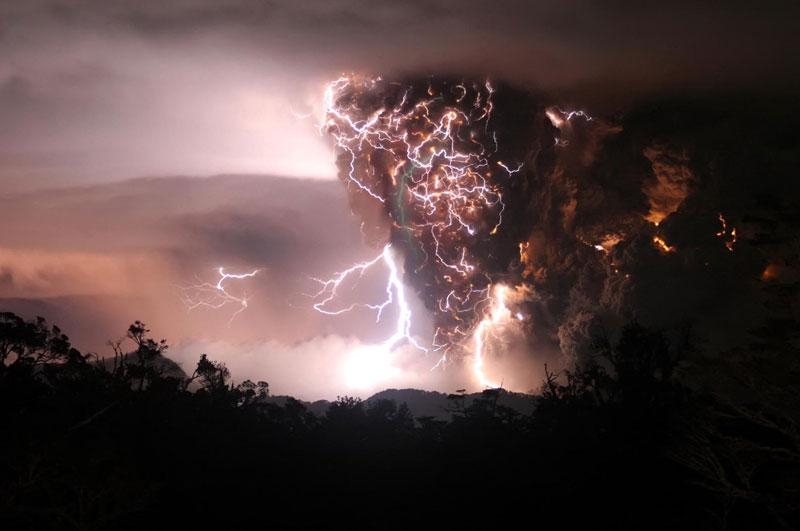
You can got a lot of extremely cool pictures out of a volcanic eruption. Giant Exploding Things That Could Kill You are always incredibly photogenic for some reason. But I think the coolest eruption pictures are the ones that involve lightning, such as this picture of the Chaitén Volcano erupting in Chilé.

Actually, I hadn't thought about it much until I saw this article, and this interesting observation:
"The seismometers were actually picking up lightning strikes," said McNutt. "I knew that I had to reach out to the physicists studying lightning."

That's just cool - lightning produced by the eruption was adding seismic noise with ground strikes.

Volcanic lightning would be a pretty interesting thing to study; the mechanism by which it forms is even less well understood than normal lightning. A possible model here at geology.com. Even more interesting is this article I found from last year, looking at the behavior of volcanic plumes.
A volcanic plume consists of a vertical column of hot gases and dust topped by an umbrella-like structure. A volcanic mesocyclone sets the entire plume rotating, causing it to spawn waterspouts or dust devils and group together the electric charges in the plume to form a sheath of lightning.

So basically, if you don't get cooked by a pyroclastic flow or burned up by magma or simply nailed in the head by flying debris, don't start feeling too good about yourself. The atmosphere might just try to kill you anyway.

Gosh, I love volcanoes.

Monday, January 25, 2010

Volcano for Monday

Philippines' Mayon Volcano to explode 'within days' - alert status has been moved from three to four, which means that an eruption is imminent. Five is when the volcano is actually erupting. Expect to see some pretty pictures of the full fury of the Earth unleashed soon, I'd say.
"Audible booming and rumbling sounds were first reported in the eastern flank of the volcano" Sunday afternoon, and 1,942 volcanic earthquakes were detected by the institute's seismic network in the 24 hours to 7 a.m. local time on Monday (6 p.m. ET on Sunday), the institute said.

Yikes. Mayon is a stratovolcano, like Mount St. Helens, which means it will tend to have eruptions of the explodey variety since its magma is viscous and doesn't allow gases to escape very effectively.

I'm kind of curious what the sulfur dioxide output it looking like for Mayon. The most recent PHIVOLCS report (from January 20) has it at 1051 tons per day. Sulfur dioxide often degasses out of magma, so a sudden jump in sulfur dioxide output is a sign that there's a lot of fresh magma coming in to the area. Apparently its previous output was around 350-500 tons per day which makes 1051 a pretty significant jump.

For comparison, the last time Mount Pinatubo blew up (in 1991), the sulfur dioxide output went from 500 tons per day to 5000 tons per day.

Wednesday, January 20, 2010

Diappointed that it's not the end of the world?

I know I've complained about this before. And I know it can't possibly be getting on my nerves as badly as it might get on the nerves of the scientists at the Yellowstone Volcano Observatory. But still, is it me, or does Time magazine's short article come across as just a little disappointed that we're not all in danger of imminent fiery death? I think the question mark at the end of the article's title ("Nothing to Fear?") is what does it.

Yellowstone is in a very tectonically active region, whether or not there's a giant magma monster lurking below the surface, ready to leap out and kill us all. From the YVO:
Although some quakes are caused by rising magma and hot-ground-water movement, many emanate from regional faults related to crustal stretching and mountain building. For example, major faults along the Teton, Madison, and Gallatin Ranges pass through the park and likely existed long before the beginning of volcanism there. Movements along many of these faults are capable of producing significant earthquakes.

It's not a surprise to see things still shifting and re-shifting in the area. Admittedly, the whole thing could blow out in a massive steam explosion tomorrow and make life extremely unpleasant for anyone in the immediate area, but it is also important to note that tectonic activity in Yellowstone doesn't necessarily mean that something's going on in the magma chambers or even the hydrothermal system.

And while I'm spending my afternoon complaining about things, I'd just like to say: A balloon boy documentary? Please, no.

Monday, January 18, 2010

Your volcano for Monday

Sorry, like last week, it's a non-explodey one. Still, this makes me happy; the Valles Caldera is being considered for inclusion in the National Park System. I visited the Valles Caldera during my last field class, and it's a beautiful area. Making it in to a national park would certainly help maintain that beauty. I even took pictures.

Monday, January 11, 2010

Your volcano for Monday

The Yellowstone caldera, where absolutely nothing of note is going on.

I swear, if I had a nickel for every time someone breathlessly told me about the apocalyptic disaster coming soon1 to the Western US when Yellowstone explodes, I'd... well, I'd have a lot of nickels, to start. I'd quite possibly be planning for an even fancier wedding too, presumably one where I could blow a giant box full of nickels on something as insipid as an ice sculpture.


1 - This is geology. Soon does not mean what you think it means.

Monday, January 04, 2010

Your volcano for Monday

Nyamuragira in the Congo is erupting. As it's one of the most active volcanoes in Africa, this isn't exactly a surprise to anyone. Nyamuragira is a shield volcano, so it tends to have runny rather than explodey eruptions.

Scientific, I know.